
Why corporate lending is still too slow?
Corporate lending decisions take up to 5 weeks. That's not a process problem, it's a revenue problem.
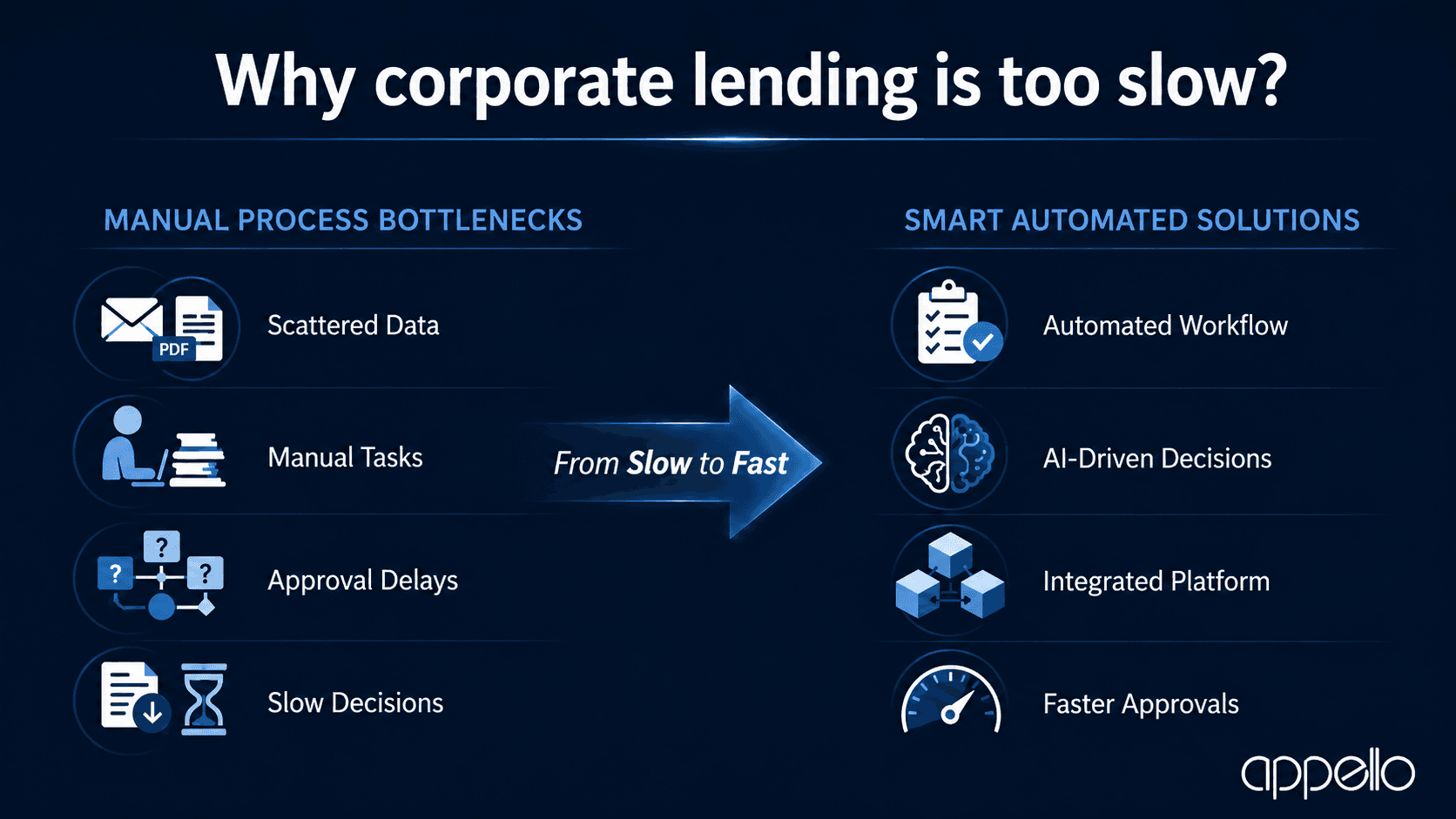
Commercial lending remains one of the most profitable areas in banking, yet it is still heavily burdened by inefficiencies. Despite ongoing digital transformation efforts, many banks continue to rely on fragmented, manual processes where data arrives through emails, PDFs, and spreadsheets, requiring repeated validation and re-entry. Responsibilities are often unclear across teams, and approval chains lack transparency, leading to unnecessary delays. As a result, credit decisions that should take hours can stretch into days or even weeks, causing banks to lose deals simply because competitors respond faster. In many cases, teams spend more time chasing information than actually making decisions.
This is not just anecdota, it is consistently confirmed by industry research. According to McKinsey & Company, corporate lending decisions still take 3–5 weeks on average, with time-to-cash reaching up to 3 months, largely due to manual processes and fragmented systems. Similarly, Accenture highlights that up to 70% of lending processes remain manual, limiting scalability and slowing response times.
The real root cause: structural inefficiency
The root cause is not just outdated technology, but the way lending processes are structured. Disconnected workflows create hidden bottlenecks throughout the entire lifecycle, from onboarding and data collection to underwriting and approval. These inefficiencies accumulate, slowing down the entire lending operation.
Research from Deloitte shows that fragmented data and siloed systems are among the top barriers to efficient lending, forcing repeated data handling and increasing operational risk. In parallel, Boston Consulting Group notes that lack of end-to-end process ownership and integration significantly increases turnaround times and cost per loan.
What leading banks are doing differently
What leading banks are doing differently is rethinking corporate lending as a connected, intelligent process rather than a series of isolated steps. By introducing end-to-end automation and flexible platforms with AI configuration features, they are able to streamline operations and significantly improve performance.
According to McKinsey & Company, banks that implement end-to-end digital lending journeys can reduce processing times by 30–50%, while also improving customer satisfaction and operational efficiency. In best-in-class cases, decision times can drop from weeks to minutes or hours, especially for standardized lending scenarios.
Automated data collection and validation eliminate the need for manual document handling, while AI-driven decisioning enables faster and more consistent credit assessments. Workflow orchestration ensures clear ownership and seamless handoffs, removing delays caused by uncertainty or manual intervention.
Flexibility and AI: the real differentiators
Equally important is flexibility. Modern lending platforms allow banks to configure products, processes, and business rules without lengthy IT development cycles, making it easier to adapt to changing market conditions and regulatory requirements.
Accenture emphasizes that high-performing banks differentiate themselves through agile, configurable architectures, enabling faster product launches and continuous process optimization.
In addition, AI enhancements—from document processing to pre-analysis—reduce the burden on teams. Deloitte highlights that AI-driven automation can significantly reduce manual workload and improve decision accuracy, allowing teams to focus on complex, value-added tasks rather than routine administration.
The measurable impact
The impact of these changes is significant and measurable:
30–50% reduction in processing time (McKinsey)
Up to 40% increase in productivity (BCG)
Lower operational costs and higher throughput (Accenture)
Improved consistency and risk control (Deloitte)
Approval cycles can be reduced from weeks to days, decision-making becomes faster and more consistent, and banks improve their ability to win deals in competitive environments.
In today’s corporate lending landscape:
Speed directly influences revenue
Transparency ensures control
Automation enables scalability
All in all, commercial lending does not have to be slow. However, achieving meaningful improvement requires a shift from manual, fragmented workflows to AI-driven, fully orchestrated processes.
Banks that make this shift are not just optimizing operations, they are fundamentally changing how they compete.
ApPello can support you in this journey. With proven experience working with Tier 1 and Tier 2 banks, we understand the real operational and IT challenges behind corporate lending transformation—and how to solve them with a flexible, AI-powered platform.
Book a short expert session and explore how to reduce your lending cycle time .
Sources
McKinsey & Company – The lending revolution: How digital credit is changing banks
McKinsey & Company – Reimagining SME and corporate lending
Deloitte – Digital transformation in lending & operations
Boston Consulting Group – Corporate banking efficiency and transformation studies
Accenture – AI and automation in banking operations